How to Choose the Right Safety Relief Valve for Your Application in 2025
In the ever-evolving landscape of industrial safety in 2025, selecting the right Safety Relief Valve is crucial for maintaining operational integrity and safeguarding personnel. Experts in the field, such as Dr. Emily Carter, a renowned safety engineer, emphasize the importance of this decision. Dr. Carter once stated, "The right Safety Relief Valve can be the difference between a controlled release of pressure and a catastrophic failure." As industries face increasing pressures and regulatory demands, the need for precise, reliable safety mechanisms becomes more apparent.
Choosing a Safety Relief Valve requires a thorough understanding of your specific application requirements, including pressure ratings, flow characteristics, and the media being handled. With advancements in engineering and materials, the available options have grown tremendously, making it essential for professionals to stay updated on the latest technologies and standards.
In this guide, we will explore key considerations and best practices for selecting the optimal Safety Relief Valve for your application, ensuring both compliance and safety in your operations. By prioritizing the right valve choice, companies can enhance their safety protocols and protect their workforce while maximizing efficiency.

Understanding Safety Relief Valves: Types and Functions
Safety relief valves are critical components in various industrial applications, designed to protect equipment and personnel from potentially hazardous
overpressure situations. These valves function by automatically venting excess pressure from a system when it exceeds a predetermined threshold.
Understanding the different types of safety relief valves and their specific functions is essential for selecting the right valve for any application.
There are primarily two types of safety relief valves: pressure relief valves and vacuum relief valves.
Pressure relief valves are commonly used in systems that operate under positive pressure, allowing for the safe release of gas or liquid when the set pressure is exceeded.
In contrast, vacuum relief valves operate in systems where a vacuum condition might develop, preventing collapse of tanks or vessels by allowing air to enter as needed.
Each type has unique features and operational principles, making it crucial to assess the specific requirements of the application, such as pressure range, medium type, and environmental conditions, to ensure optimal safety and performance.
Evaluating Application Requirements for Safety Relief Valve Selection
When selecting a safety relief valve for your specific application, it is crucial to evaluate the operating conditions and requirements carefully. Start by assessing the type of medium being contained, whether it's gas, liquid, or a combination, as each medium has different properties that affect valve performance. Additionally, consider the temperature and pressure ranges in which the valve will operate. The valve must be capable of handling maximum pressure and temperature conditions to ensure safety and reliability. Understanding these parameters is essential in determining the proper specifications for the safety relief valve.
Furthermore, flow capacity and type of discharge should be taken into account. You need to analyze the expected flow rates during an overpressure event to ensure the chosen valve can handle the required discharge without causing system failure. It is also important to evaluate the installation environment, which may influence the choice between a traditional or a spring-loaded safety relief valve. Finally, consider maintenance and accessibility, as a valve that is difficult to reach may increase downtime and operational risks. Taking a comprehensive approach to these evaluation criteria will greatly assist in selecting the right safety relief valve for your application in 2025.
Key Considerations in Sizing a Safety Relief Valve
When selecting a safety relief valve, one of the primary considerations in sizing is the flow rate requirements of the system it will protect. This involves understanding the maximum expected flow in the event of overpressure, which can be determined through calculations that factor in the process conditions. Consideration should also be given to the specific application, including the nature of the fluid—whether it’s gas, liquid, or steam—as different fluids have distinct characteristics that impact flow rates and pressure responses.
Another important aspect of sizing a safety relief valve is the set pressure, which is the point at which the valve will open to relieve excess pressure. This set point must align with the system's operating conditions to ensure safety without compromising efficiency. Additionally, factors such as the temperature of the process, the specific gravity of the fluid, and the discharge system configuration are critical to properly sizing the valve. Engineers must ensure that these parameters are accurately assessed to select a valve that not only meets regulatory requirements but also provides reliable performance under various operational scenarios.
Materials and Compatibility: Choosing the Right Safety Relief Valve
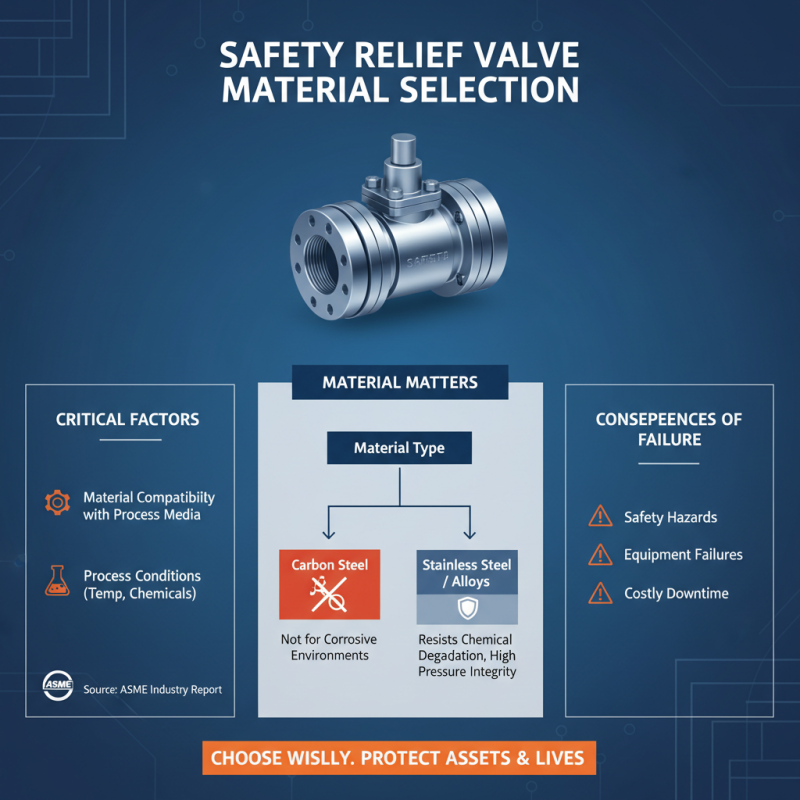
When selecting a safety relief valve for specific applications, the materials used in its construction and their compatibility with the process media are critical factors to consider. According to an industry report by the American Society of Mechanical Engineers (ASME), failure to properly assess material compatibility can lead to significant safety hazards, equipment failures, and costly downtimes. For instance, valves made from carbon steel may not be suitable for corrosive environments, while those constructed from stainless steel or specialized alloys can effectively resist chemical degradation and maintain integrity under high-pressure conditions. These insights underline the importance of understanding the process conditions, including temperature fluctuations and the presence of aggressive chemicals, which ultimately dictate the choice of materials.
Furthermore, the Materials Compatibility Guide published by the National Association of Corrosion Engineers (NACE) highlights the necessity of considering specific chemical interactions when choosing valve materials. For example, compatibility tests have shown that EPDM rubber seals offer superior performance in steam applications, while fluoropolymers are often preferred in highly corrosive scenarios. Using such data, engineers can make informed decisions that not only enhance the safety and reliability of the valve but also align with regulatory standards. As we advance towards 2025 and beyond, the emphasis on selecting the right materials will become increasingly paramount in ensuring both operational efficiency and compliance with emerging safety regulations in various industries.
Future Trends: Innovations in Safety Relief Valve Technology for 2025
In 2025, the safety relief valve industry is poised for significant advancements driven by innovations in technology. One of the key trends is the integration of smart technology into safety relief valves. These advanced systems will utilize IoT connectivity to monitor real-time pressure conditions, enabling automation and enhanced safety protocols.
Data analytics will play a crucial role in predicting potential failures, allowing operators to initiate preventive maintenance before issues arise, thus reducing downtime and improving operational efficiency.
Additionally, materials science advancements are set to revolutionize the safety relief valve market. The development of lightweight, corrosion-resistant materials will lead to valves that not only last longer but also operate efficiently in extreme conditions. This shift will cater to industries such as oil and gas, where equipment must withstand harsh environments.
Furthermore, the ongoing development of 3D printing technologies will facilitate the rapid prototyping of customized relief valves, allowing for more specialized applications and quicker responses to market demands. This convergence of smart technology and innovative materials will redefine safety standards and performance expectations in the industry.